Once upon a time (aka June, 2012) Kelly Jensen and I presented on passive programming at ALA Annual in Anaheim. It was a delightfully nerve-wracking experience. Afterward, we were asked to write an article on the subject of our talk. Today, many moons later, that article has posted with Programming Librarian, and can be read here.
Feedback and your experiences with the subject are welcome!
One thing that Kelly and I were very committed to including were specific examples of how you can implement our recommendations (some culled from personal experience, some are well-known adaptations, and some are blatantly stolen from here and there). Nothing frustrates me more when reading professional material than eight paragraphs of how awesome this thing that librarian did was, followed up with zero practical info about how to reproduce it. It wastes everyone's time, and frankly, it's tacky self-promo in a space that should be more about professional enrichment, advice, and inspiration (I has a beef*). That was exactly the opposite what Kelly and I were going for. Not that we want to be all touchy-feely objects of inspiration. That would be gross. Our goal was more of the line of thinking about reaching different segments of your teen population. Which is pretty much what we said in our last paragraph:
"Passive programming gives teens another avenue and level in which to interact and connect with the library. It will hopefully lead to larger, more obvious engagement, but even if it doesn’t, even if a teen never once actually participates in a passive program, those teens will still have seen the effort. Whether or not they embrace the activities, it communicates to them that they are wanted and valued; that the teen area is truly their space. That’s the long game. We want patrons, no matter their age, to understand that they own the library."
ANYWAY. We did a thing, and even though the whole package, including the presentation** has been something Kelly & I have been thinking about and experimenting with for well (well) over a year now, I, apparently, still feel strongly about the subject. So, give it a read. See if you can apply any of it to your library or life. Let us know how it turns out.
*It's really hard for me to find time to read professional journals. I get cranky when you don't give me the tools for reproduction. Don't bother writing if you're going to be all selfish about it. /meanieness
**speech notes can be found here, and the Prezi here.
Wednesday, April 03, 2013
Monday, April 01, 2013
Missing in Teen: The 600s
I'm working my way through weeding the 600s in teen non-fiction. The first step, for me, is to get rid of some of the stuff that hasn't circulated in at least a year. What this also catches are books that have disappeared. Walked off. Maybe hiding under the ficus.
Teen 613.83 Harmon
Hallucinogens: The Dangers of Distorted Reality
Daniel E. Harmon
Teen 613.9071 Kemp
Healthy Sexuality
Kristen Kemp
Teen 613.951 Shaw
This Book is About Sex
Tucker Shaw
Teen 614.17 Denega
Skulls and Skeletons
Danielle Denega
Teen 618.9285 Attenti
Attention Deficit/Hyperactivity Disorder
William Dudley
Teen 637.7 Garza
Stuff on My Mutt
Mario Garza
Teen 646.3083 Warrick
Style Trix for Cool Chix
Leanne Warrick
Teen 646.7008 Shaw
--Any Advice?
Tucker Shaw
I don't think that there are really any conclusions to be made, but it's probably a decent look at what type of stuff is popular in the Dewy century. I should compare this to the teen titles that do actually have the highest recorded circulation, although I have no doubt that, with maybe the exception of the ADHD title, these are all the type of browsable nf that teens will look at in the library and not check out. Or, you know, steal.
Hallucinogens: The Dangers of Distorted Reality
Daniel E. Harmon
Healthy Sexuality
Kristen Kemp
This Book is About Sex
Tucker Shaw
Skulls and Skeletons
Danielle Denega
Teen 618.9285 Attenti
Attention Deficit/Hyperactivity Disorder
William Dudley
Teen 637.7 Garza
Stuff on My Mutt
Mario Garza
Teen 646.3083 Warrick
Style Trix for Cool Chix
Leanne Warrick
Teen 646.7008 Shaw
--Any Advice?
Tucker Shaw
I don't think that there are really any conclusions to be made, but it's probably a decent look at what type of stuff is popular in the Dewy century. I should compare this to the teen titles that do actually have the highest recorded circulation, although I have no doubt that, with maybe the exception of the ADHD title, these are all the type of browsable nf that teens will look at in the library and not check out. Or, you know, steal.
Sunday, July 15, 2012
The Last Princess or Beware of Fruit
I stole The Last Princess by Galaxy Craze from my fake boss at her birthday party last night. I read it in one sitting, so there is obviously a lot going right in the novel. But that's less interesting than talking about the niggling issues I have about it that sully the fact that it was obviously a unique approach to the post-apocalyptic trend and very well paced.Catastrophic events led to every natural disaster you can think of battering the Earth. After the Seventeen Days, the British Royalty emerged from their bomb shelter beneath Buckingham Palace. All communication was down, so they sent a ship to contact someone, anyone, outside of England. That ship never returned. For all any of the English know, they are the last people in alive in the world. With the environment ravaged, and the sun dropping flaming bits of itself for further destruction, most of the country is starving. Badly enough that in some quarters cannibals roam what remains of forrests. There is civil unrest, and it's going to kill the king and queen -Eliza's parents.
I would say that my biggest issue starts with the fact that it is made very clear on page 13 that Eliza isn't supposed to be a helpless girl:
"After the Seventeen Days, without phones or computers or television, Mary [elder sister] and I amused ourselves play-fighting with the Royal Swords. The Master of Arms gave us lessons, teaching us to slash, stab, and parry. Mary and I would fence against each other, betting on the little luxuries that were still left over from before: a square of Cadbury chocolate, a piece of spearmint gum. Later, when the government food rations were gone, we would take spears and throwing knives to the woods around Balmoral, hunting the snakes and pigeons and few other creatures that remained. I was surprised to find that I had quite good aim, unlike Mary, who never could get the hang of throwing a knife."
Despite her obvious natural skills that were trained over the course of several years with, presumably, one of the best teachers one would find in England, Eliza, at practically every turn, gets saved by the boy. This is not to say that she doesn't fight, or even have modest success at hand-to-hand combat, but that 9 out of 10 times, when she's in dire straights, the love interest, Wesley, suddenly appears to get her out of the situation.
My second issue gets spoilery. So, massive civil unrest leads to a coup. Eliza barely escapes alive, her parents are dead, her brother and sister have been captured but are inexplicably being kept alive. For months. The leader of the insurection has made no secret of his intention to crown himself king. Why keep two heirs around to threaten your legitimacy? Futhermore, and more importantly, as we near the end, the populace, needing only an inspirational heroine they obviously find in Eliza, rise up against the over-the-top evil of the insurection. They conquer Newcastle by surprise and suffer little to no loss despite their inferior numbers, training, and weaponry. Getting to this fighting back stage happens all to quickly and cleanly, and unlike real war, no one close to Eliza is ever seriously wounded, let alone killed. Except her poor expendable parents whose deaths more or less start everything off.
Also, horses seem to travel preternaturally fast in this book. I can't say for certain as time passage was vague, but as Eliza flees London on her stolen warhorse she sees a sign saying "Scotland 380 miles" (p 189). Two short chapters, a nap, and a couple of dispatched cannibals later, she's made it to Balmoral Castle, which, according to Google Maps is 510 miles away from the Tower of London. I had to look it up, but a good day's travel on horseback is about 30 miles. No big.
Few teens are going to care about the speed a horse travels, or that battle goes too easily, nor that there is no depth or dimention given to the villians. Only some will care that the princess gets saved. A LOT. None of these things will keep me from recommending the book. Neither does it stop the obnoxious "BUTs" that ricochet around my brain.
Friday, June 08, 2012
Don't Accept Sexism or Today in Don't Piss Off Twitter:
I really, really didn't think much about yesterday's post about the blatant sexism in Scholastic's Survive Anything books. I opened my committee box from Scholastic, and there they were. I couldn't not look at them, and I couldn't help but notice how it played into gender stereotypes in a shockingly obvious and stupidly offensive way. So I dusted off this blog and wrote a fairly minimalist entry, trusting that in typing out the table of contents the books would speak for themselves. They did.
I didn't expect it to spread through Twitter like WILDFIRE. I figured a few of my friends would find it as obnoxious as I, but I didn't expect the great Ryan North (incidentally, my husband's IDOL, no joke) to pick it up (with a fat cut & paste no less) and run with it all over the place. I spent the day talking to 700 middle school students about books, reading, and the library, so what happened next is really all your story. You spread the issue thousands upon thousands of times on Twitter. You linked to it on Facebook, on Tumblr, and Reddit. It was picked up by BuzzFeed and Jezebel (Jezebel, in a failed example of journalism, didn't credit me, but whatevs).
And Scholastic? They heard you. In a terse post, they announced that no further copies will be made available." Whatever that means. No additional printings would be my guess.
Which puts me in sort of a strange mind. On one hand, VICTORY! We have stood up for our children and refused gender boxes! On the other, there wasn't really anything wrong with most (definitely not all - some of the girl language was downright patronizing) of the content, just that it assigned specific gender roles in a nonsensical out-dated, way. Objections would not have been had if Boys Only! and Girls Only! hadn't appeared on the cover. Make them gender neutral, and it's possible I would have talked these up to the couple thousand students I see this time of year. So, now that these books are no more, my little librarian mind is confused: Did I just instigate some sort of progressive-minded censorship? Regardless, let's hope that Scholastic will keep this in mind the next time they think creating gendered books is spiffy keen.
For some lols, check out the apology North wanted to get from Scholastic.
John Green is Mostly Wrong
At BEA Children's Book and Author Breakfast:
"There's a lot of talk about enhanced e-books," Green said. "What we do best does not need or benefit from what we call enhancement. We are good at giving people rich and immersive experiences. I believe story trumps everything." After a round of applause, he continued, "To be fair, it's like being in a room full of elephants, talking to elephants about how great elephants are." -via Shelf Awareness
And that's what happens when you speak in a vacuum. You say things that have a pesky tendency to be impossible absolutes. Story does trump everything. It trumps mediocre writing, and it's why Stephanie Meyer and Rick Riordan are wealthy. But words are not the only way to tell a story.
I have to confess here that I have a somewhat vested interest in this topic. Not financial or anything, but I'm going to be speaking at YALSA's 2012 YA Literature Symposium about transmedia,* an element of which lately, is often manifesting as "enhanced e-books." I've been thinking about them for a long time. Green might exist in a world full of really good, eager readers, who don't desire anything more than the world they create in their mind. However, to say that story can not benefit from additional media shortchanges the potential of an art form. You might not care for watercolor, but it doesn't make it intrinsically of less value artistically than oil paint. Nor does it make that painting as a whole of less value, or the story that it tells less rich. It's just a different media. Stories don't need a printing press.
John Green may not feel that his novels will benefit from any "enhancements." I feel that Okay for Now by Gary D. Schmidt and the Leviathan series by Westerfeld benefited from illustrations. I feel that the audio version of The Invention of Hugo Cabret benefited from sound effects. I feel that Chopsticks by Jessica Anthony and Rodrigo Corral benefited from the embedded youtube clips in the e-book version, rather than just the link text in the print format. I believe that John Green should spend some time with Patrick Carmen.
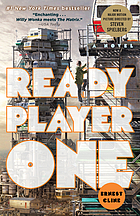
Imagine reading an ebook where the author triggers specifically chosen or created music based on the page you're on. Imagine if Don Calame's Call the Shots (out in Sept) included video clips of the horror movie the characters are making. What if Erebos let you join in on one of the MMORP quests? If Ready Player One showed clips of the movie references, or played the songs, or let you play one of the video games? Is it needed? Nah. But I won't claim that it wouldn't benefit.
Nor would I claim that the integration of such enhancements doesn't appeal to those who look at a page full of text and walk away. Based on his books, I doubt that Green has much contact with truly reluctant readers, so maybe he doesn't see how transmedia (telling a story across formats) might appeal to those readers. It can break up text. It can help bridge comprehension barriers. It can provide an online forum full of resources for additional engagement (something Green knows a bit about).
Green's "what we do best" refers to writing, and writing alone. Enhanced ebooks won't succeed if the story isn't good enough. But neither will theater. Or art. Or music. Or video games. Or anything else that creates a "rich and immersive experience." Saying, believing, otherwise just tells me you aren't as creative as you maybe think you are.
But then, writing the same characters in four unrelated books maybe already told me that.**
What many authors do best certainly is writing, and that's why illustrators are hired. That's why collaboration exists - to create outside of a vacuum. Enhanced e-books and transmedia simply mean that collaboration can now include more people committed to that story. What authors are really good at is having a vision; making up a world where possibilities are endless. Why, John Green, limit yourself merely to words?
---
*When a Book is More Than Paper: Transmedia Trends in YA Literature
**Ok, that was mean. Pot shots are cheap. But, outside of the personal aspersion, a completely valid critique of his work. I suspect that JG can handle it.
Thursday, June 07, 2012
Sexist Much?
Boys Only: How to Survive Anything!
Table of Contents:
- How to Survive a shark attack
- How to Survive in a Forest
- How to Survive Frostbite
- How to Survive a Plane Crash
- How to Survive in the Desert
- How to Survive a Polar Bear Attack
- How to Survive a Flash Flood
- How to Survive a Broken Leg
- How to Survive an Earthquake
- How to Survive a Forest Fire
- How to Survive in a Whiteout
- How to Survive a Zombie Invasion
- How to Survive a Snakebite
- How to Survive if Your Parachute Fails
- How to Survive a Croc Attack
- How to Survive a Lightning Strike
- How to Survive a T-Rex
- How to Survive Whitewater Rapids
- How to Survive a Sinking Ship
- How to Survive a Vampire Attack
- How to Survive an Avalanche
- How to Survive a Tornado
- How to Survive Quicksand
- How to Survive a Fall
- How to Survive a Swarm of Bees
- How to Survive in Space
Girls Only: How to Survive Anything!
Table of Contents:
- How to survive a BFF Fight
- How to Survive Soccer Tryouts
- How to Survive a Breakout
- How to Show You're Sorry (and chapter 3 is where we no longer care about "survival")
- How to Have the Best Sleepover Ever
- How to Take the Perfect School Photo
- How to Survive Brothers
- Scary Survival Dos and Don'ts ("don't throw things or yell at your ghost. it may react badly.")
- How to Handle Becoming Rich
- How to Keep Stuff Secret
- How to Survive Tests
- How to Survive Shyness
- How to Handle Sudden Stardom
- More Stardom Survival Tips
- How to Survive a Camping Trip ("fresh air is excellent for the skin")
- How to Survive a Fashion Disaster
- How to Teach Your Cat to Sit (are you #$&^%*@ kidding me?)
- How to Turn a No Into a Yes
- Top Tips for Speechmaking
- How to Survive Embarrassment
- How to Be a Mind Reader
- How to Survive a Crush
- Seaside Survival (don't wear heels. tie your hair back. sunglasses add glamour.)
- How to Soothe Sunburn
- How to Pick Perfect Sunglasses
- Surviving a Zombie Attack
- How to Spot a Frenemy
- Brilliant Boredom Busters
- How to Survive Truth or Dare
- How to Beat Bullies
- How to be an Amazing Babysitter
Monday, January 30, 2012
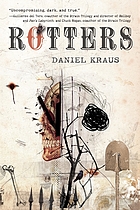
Rotters or Let's All Just Get Cremated
Joey Crouch's mom is dead. He's in nowhere Iowa where people hate him just because of his strange and very smelly dad, who locals refer to as The Garbage Man. What his dad actually does is far more disgusting than waste management - he's a grave robber and the scent of rotting corpses clings to him. Soon, the grime and stink of his father's illegal trade will cling to Joey, too. This will bring him more difficulties than adjusting to a new town and getting over his mother's death. It will bring with it a familiarity of death and decay and danger.
The opening is magnificent. Joey catalogues all the ways his mother could die, but doesn't, ending with her actual death. The rest of the novel is propelled from that point, both in how his life changes, and how the past brought about his mother's death, and his future.
However, after that there's almost 200 pages of set-up. It's not unnecessary, and it's vital to Joey's character development, but between the gorgeous prologue and page 195, (where we're treated to a rousing and detailed explanation on how to escape being buried alive - and yes, I've committed this to memory, Lord save me. One must be prepared for anything), there is little to truly advance the plot, and is, therefore, the weakest portion of the story. Daniel Kraus' language is strong, but the school bullies, especially Woody and Celeste, are generic, lack depth, and could be transplanted to any book where bullies are required and fit right in. The first 200 pages is primarily devoted to making Joey miserable enough that he's able to descend low enough for the rest of the book to happen.
Science teacher Gottschalk was extreme, but not overboard, until the reproduction lesson on pages 142-3. Here he crosses over into sexual harassment of Joey, which seemed too much, given the character was cruel, but didn't seem stupid, and there's no real way to know that someone wouldn't rat him out to someone else who would make a stir. Gottschalk by action and even previous speech clearly felt he was a law upon himself in that school, and based on the behavior of the principal and vice-principal, I can see why - but those two did respond to incidents that could result in bad press, and this was surly one of those. Although it did not.
Continuing with first half character issues, is Boris and his family. They were so close to Joey that they shared his grief, and took him in until his father could be found, but Boris more of less immediately drops him? His parents never inquire after him? Make any overtures? When my reading of the situation was that had his father not been reached, it was likely that he'd just stay with them permanently? I know that this was done to further isolate Joey, but why even have the family in the story? Why not just throw him in temporary foster care after his mom dies? It'd be much easier for me to believe that some sketch foster family didn't care about him after he left, than Boris' family. But then, without friends, Joey had less to lose.
The grief and alienation of the first half of the book, leads to a desperation so strong that once Joey is brought into the "digger" clan, and is bestowed a nickname, "Son", he muses, "I felt an unexpected rush: If I were given one of these names, I would be part of a club. I would no longer be alone" p225. It's all he has, it's his only option, and, as he did with his academics, he throws himself all in. Into grave robbing.
Enter Boggs, who is a fantastic, believable, horror villain in his invincibility, psychosis, and grotesqueness. He he seriously one of the best villains I've encountered in ages, and it is his mania, unpredictability, and, er, villainy that propels the last fourth (plus) of the book. Unfortunately, it takes him far too long to enter the story. I would have liked, at the very least, more build-up or foreshadowing regarding him, to work us up to a good lather, since, let's be honest, yeah, there's the whole self-discovery, bildungsroman thing going on, but it's Boggs who gets the plot moving, and Boggs who drives Joey into the rocks at the bottom.
The details of grave robbing are fascinating, as are the rather disgusting details of decomposition. These are largely what keep the reader going during the first portion of the book. I should have pulled some of the really disgusting quotes for you, but I didn't think of it at the time, oh, wait, that's what Amazon's Search Inside is for. Let's just enter a rather unique phrase I remember, "coffin liquor." Yes, that'll do.
If you happen to be eating, I'd skip this next quote. Don't say I didn't warn you.
"I concentrated on my father. He was dealing with another ring that wouldn't dislodge from its puffy finger. He let the hand drop and it smacked into two inches of black slime. We call that coffin liquor, my father said as he reached for his wire cutter, and it's the result of bacteria in the casket's vacuum turning the corpse to mud. I watched him take the woman's left hand. Most of the skin sloughed off in a single sheet like a translucent glove - slip skin, my father assure me, nothing more. He let the skin dissolve into the coffin liquor and regripped the moist green hand. I noted with dull astonishment that the woman's nails were painted candy pink" p 110.
lalala. But really, you can't look away from that, right? And imagine your teens' reactions? Oh, I'm almost tempted to read that paragraph aloud during my next book talks... excellent.
I do think, ultimately, despite taking it to task above, that this is an excellent book. And if you can stomach (or revel) in that last quote, you definitely should read it. Or at least know who should.
On bullying: "The noses of the Incorruptibles [the popular bullies] were trained to detect fear, and in my metamorphosis to the Son I had lost that musk. A new target, therefore, had been chosen" p 350.
The question remains of whether or not there are grave robbers among us...
Saturday, January 21, 2012
Annual Wild Guesses for the ALA Youth Media Award
I think I'm going to skip the live stream of the announcement this year. Largely because it's not on MLK day, which means I'll have to work, and getting up at 5:30 am on a workday doesn't sound as good as being able to go back to bed after the announcement. But we'll see.
Printz
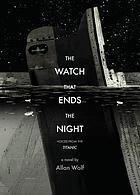
The Watch that Ends the Night by Allan Wolf
Honest truth? I was bored out of my mind for the most part - and still flummoxed that anything about the Titanic could ever be boring, but this one managed it. HOWEVER, I can acknowledge that it is very literary. The biggest hurdle Watch will need to overcome is whether or not the committee thinks the enormous cast of characters is hindered by its sheer size. The fact that the reader spends so little time with each voice may result in less passionate arguments - and arguments that some characters are superfluous or under developed (not all, some were palpably wonderful, but they were buried in the avalanche of voices and struggle to be heard through the melee). The appendix is excellent and massively interesting, though, highlighting that the research was thorough. Watch will get bonus points for that.
Life, An Exploded Diagram by Mal Peet
So I'm a little unsure this is really a book for teens, despite it's publishing status. However, Peet has yet to be recognized by this award, and Life might be the book to do it. The fact that only a very small portion of the narrative is devoted to teen characters may hurt it's chances.
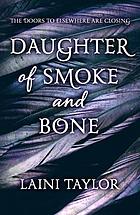
Daughter of Smoke and Bone by Laini Taylor
I think the librarians who buzz about these things will be shocked if this doesn't get recognized. Shocked. I think that if there was gambling on the Printz outcome, this is likely the safe money. It transcends ilk in language, structure, world-building, and originality. It's ultimately a paranormal romance with angels, which you'd think would be kryptonite to adult readers of YA by now, but there's always an epic quality to Taylor's writing, and never moreso than here.
Rotters by Daniel Kraus
This is probably a bit of a dark horse, but I absolutely wouldn't be surprised to see this horror story get a nod. It all comes down to the composition of the committee, and whether they can stomach it (not that they aren't objective, they are, but... Rotters is gross. More on that later [as in I have a post-worth to say about it].).
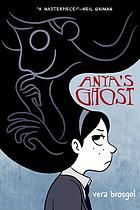
Anya's Ghost by Vera Brosgol
Buzz for this seems to have dropped off some, but including it, especially with the Wolf and Peet might be thought to balance out the list, and would represent only the second time a graphic novel has been recognized by the Printz. Anya's art is supurb, and the illustrations speak just as loudly as the words, which is exactly why this is worth looking at.
The Piper's Son by Melina Marchetta
I confess that historically Marchetta and I don't jibe, and I have put off reading Piper because of that. It seems to me that the world of YA readers breaks down into those who love Marchetta, and those who do not. Those who do are rabid, and I'll concede there is a lyrical quality to her language and that her characters are robust, but her plotting dives me batty.
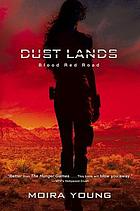
Blood Red Road by Moira Young
I'm not holding my breath for this to be recognized, but it was the Costa winner, and I loves it with all my hearts. Not a big fan of the cover (or title) of the sequel, though it won't stop me from reading it as soon as I can possibly get my hands on it.
The Scorpio Races by Maggie Stiefvater
It has a lot of starred reviews, but while I haven't read it (it's next up), I've never warmed to Stiefvater's language. I wouldn't be shocked if it was announced, but... I don't know. My gut instinct doesn't go there. But perhaps I'd change my tune if I had/have enough time to read it before the announcement.
Newbery
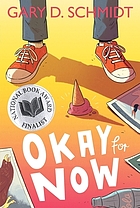
Okay for Now by Gary Schmidt
Schmidt is well-loved and this one (which won my system's mock Printz) is definitely adored, despite an over-the-top ending that could seriously hurt its chances. While I believe the ending was a misstep plot-wise, I can't say that I wouldn't be anything but happy if this ends up with a medal. While it would be eligible for the Printz, I think it's chances are better with the Newbery.
A Monster Calls by Patrick Ness
I always though that Ness was British, but I guess he just lives there? If he's still a citizen of the US, then this is eligible, and stands a good chance. Would this be more comfortably set in Printz catagory? Probably, and then we wouldn't have to think about citizenship issues, which make my head hurt.
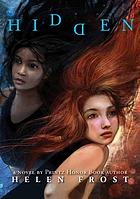
Hidden by Helen Frost
Likewise inhabiting that tough zone in between middle grade and YA, I think Hidden could find a home here. Frost got a Printz honor back in 2004 for Keesha's House, but despite that, I feel that she's largely underrated. She continually shows how verse novels should be done, and force you to take them more seriously than many of the popular free-verse examples would lead you to believe. She is innovative in form and structure. There's nothing wrong, and many thing right, with free verse, but Frost hammers home how much more the verse novel can do than simply be sparse. *ducks*
Tuesdays at the Castle by Jessica Day George
I don't know if this is a real contender, but it's sweet, fun, and clever, and I think it would be lovely to recognize this in the vein of Princess Academy. Regardless, I believe that someday George will get a silver or gold SOMETHING.
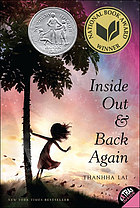
Inside Out and Back Again by Thanhha Lai
To my recollection there aren't many National Book Award finalists that crossover to the Youth Media Awards, but this would be the one to do it this year.
Breadcrumbs by Anne Ursu
Selecting Breadcrumbs would be a crowd-pleaser. I haven't read it yet, I'm still on the waiting list, but with at least three starred reviews and an entire community worth of Twitter buzz behind it, you know the committee has read it. I really do think I'm the only one who hasn't read it at this point. This probably has the best odds.
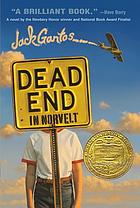
Dead End in Norvelt by Jack Gantos
In direct competition with Okay for Now, will this be an either or? Or will they split the vote and usher in a lesser-known? Of course, we've seen more than one girl-protag historical in one year before, so both would make it an amusing turn-around. But Gantos has more of the gross-out ground covered, and depending on how prim our committee is, Norvelt could take a hit.
Caldecott
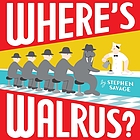
I like I Want My Hat Back by J. Klassen and Where's Walrus by Stephen Savage. But let's be obvious here, my picture book cred is random and not to be trusted.
Morris
We already know the finalists. My imaginary money is on either Girl of Fire and Thornes or Where Things Come Back. I don't know why but I don't think it'll be Paper Covers Rock or Under the Mesquite. Which leaves Between Shades of Gray as a wildcard. My heart is with Where Things Come Back, as you probably know.
Coretta Scott King
Bronxwood by Coe Booth was good, but had a touch of the middle book syndrome, so look to Ghetto Cowboy by G. Neri and Heart and Soul by Kadir Nelson to be recognized.
Schneider
I'm wracking my brain here and having a tough time isolating the titles I'm aware of that would be eligible. Stick by Andrew Smith comes to mind. There's way more in the abuse and other topics that take center stage, and there are ending issues (a common refrain this year), but Stick is noteworthy. I'd love to see Sean Griswold's Head by Lindsey Leavitt recognized, but it's much more about a daughter coping with her own issues that are triggered and magnified by her father's illness than about the dad's disease - which definitely meets criteria, but I think the focus is nevertheless unlikely to match with the Schneider. It is an absolutely delightful read, though. Compulsion by Heidi Ayarbe, is utterly compelling, but the ending isn't as hopeful as these tend to be. And that's what I've got. That I can think of.
Alex

The Night Circus by Erin Morgenstern andRoom by Emma Donoghue* are easy targets for inclusion on this list. I wonder if Ready Player One might be, as well, although I don't know if the heavy 80's references are a plus or a minus for its chances. I haven't read any of them, but I'm waiting for RPO's audio book to come in. A collegue enlightened me to the fact that Wil Wheaton narrates and that it is awesome in general and hilarious in specific when Wheaton is forced read aloud about himself.
*For some reason my brain forgot what year it was by the end of this massive post. Room was of course recognized by the Alex in 2011, as DDB pointed out on my Facebook link to this post. *faceplant*
Printz
Honest truth? I was bored out of my mind for the most part - and still flummoxed that anything about the Titanic could ever be boring, but this one managed it. HOWEVER, I can acknowledge that it is very literary. The biggest hurdle Watch will need to overcome is whether or not the committee thinks the enormous cast of characters is hindered by its sheer size. The fact that the reader spends so little time with each voice may result in less passionate arguments - and arguments that some characters are superfluous or under developed (not all, some were palpably wonderful, but they were buried in the avalanche of voices and struggle to be heard through the melee). The appendix is excellent and massively interesting, though, highlighting that the research was thorough. Watch will get bonus points for that.
Life, An Exploded Diagram by Mal Peet
So I'm a little unsure this is really a book for teens, despite it's publishing status. However, Peet has yet to be recognized by this award, and Life might be the book to do it. The fact that only a very small portion of the narrative is devoted to teen characters may hurt it's chances.
I think the librarians who buzz about these things will be shocked if this doesn't get recognized. Shocked. I think that if there was gambling on the Printz outcome, this is likely the safe money. It transcends ilk in language, structure, world-building, and originality. It's ultimately a paranormal romance with angels, which you'd think would be kryptonite to adult readers of YA by now, but there's always an epic quality to Taylor's writing, and never moreso than here.
Rotters by Daniel Kraus
This is probably a bit of a dark horse, but I absolutely wouldn't be surprised to see this horror story get a nod. It all comes down to the composition of the committee, and whether they can stomach it (not that they aren't objective, they are, but... Rotters is gross. More on that later [as in I have a post-worth to say about it].).
Buzz for this seems to have dropped off some, but including it, especially with the Wolf and Peet might be thought to balance out the list, and would represent only the second time a graphic novel has been recognized by the Printz. Anya's art is supurb, and the illustrations speak just as loudly as the words, which is exactly why this is worth looking at.
The Piper's Son by Melina Marchetta
I confess that historically Marchetta and I don't jibe, and I have put off reading Piper because of that. It seems to me that the world of YA readers breaks down into those who love Marchetta, and those who do not. Those who do are rabid, and I'll concede there is a lyrical quality to her language and that her characters are robust, but her plotting dives me batty.
I'm not holding my breath for this to be recognized, but it was the Costa winner, and I loves it with all my hearts. Not a big fan of the cover (or title) of the sequel, though it won't stop me from reading it as soon as I can possibly get my hands on it.
The Scorpio Races by Maggie Stiefvater
It has a lot of starred reviews, but while I haven't read it (it's next up), I've never warmed to Stiefvater's language. I wouldn't be shocked if it was announced, but... I don't know. My gut instinct doesn't go there. But perhaps I'd change my tune if I had/have enough time to read it before the announcement.
Newbery
Schmidt is well-loved and this one (which won my system's mock Printz) is definitely adored, despite an over-the-top ending that could seriously hurt its chances. While I believe the ending was a misstep plot-wise, I can't say that I wouldn't be anything but happy if this ends up with a medal. While it would be eligible for the Printz, I think it's chances are better with the Newbery.
A Monster Calls by Patrick Ness
I always though that Ness was British, but I guess he just lives there? If he's still a citizen of the US, then this is eligible, and stands a good chance. Would this be more comfortably set in Printz catagory? Probably, and then we wouldn't have to think about citizenship issues, which make my head hurt.
Likewise inhabiting that tough zone in between middle grade and YA, I think Hidden could find a home here. Frost got a Printz honor back in 2004 for Keesha's House, but despite that, I feel that she's largely underrated. She continually shows how verse novels should be done, and force you to take them more seriously than many of the popular free-verse examples would lead you to believe. She is innovative in form and structure. There's nothing wrong, and many thing right, with free verse, but Frost hammers home how much more the verse novel can do than simply be sparse. *ducks*
Tuesdays at the Castle by Jessica Day George
I don't know if this is a real contender, but it's sweet, fun, and clever, and I think it would be lovely to recognize this in the vein of Princess Academy. Regardless, I believe that someday George will get a silver or gold SOMETHING.
To my recollection there aren't many National Book Award finalists that crossover to the Youth Media Awards, but this would be the one to do it this year.
Breadcrumbs by Anne Ursu
Selecting Breadcrumbs would be a crowd-pleaser. I haven't read it yet, I'm still on the waiting list, but with at least three starred reviews and an entire community worth of Twitter buzz behind it, you know the committee has read it. I really do think I'm the only one who hasn't read it at this point. This probably has the best odds.
In direct competition with Okay for Now, will this be an either or? Or will they split the vote and usher in a lesser-known? Of course, we've seen more than one girl-protag historical in one year before, so both would make it an amusing turn-around. But Gantos has more of the gross-out ground covered, and depending on how prim our committee is, Norvelt could take a hit.
I like I Want My Hat Back by J. Klassen and Where's Walrus by Stephen Savage. But let's be obvious here, my picture book cred is random and not to be trusted.
Morris
We already know the finalists. My imaginary money is on either Girl of Fire and Thornes or Where Things Come Back. I don't know why but I don't think it'll be Paper Covers Rock or Under the Mesquite. Which leaves Between Shades of Gray as a wildcard. My heart is with Where Things Come Back, as you probably know.
Coretta Scott King
Bronxwood by Coe Booth was good, but had a touch of the middle book syndrome, so look to Ghetto Cowboy by G. Neri and Heart and Soul by Kadir Nelson to be recognized.
Schneider
I'm wracking my brain here and having a tough time isolating the titles I'm aware of that would be eligible. Stick by Andrew Smith comes to mind. There's way more in the abuse and other topics that take center stage, and there are ending issues (a common refrain this year), but Stick is noteworthy. I'd love to see Sean Griswold's Head by Lindsey Leavitt recognized, but it's much more about a daughter coping with her own issues that are triggered and magnified by her father's illness than about the dad's disease - which definitely meets criteria, but I think the focus is nevertheless unlikely to match with the Schneider. It is an absolutely delightful read, though. Compulsion by Heidi Ayarbe, is utterly compelling, but the ending isn't as hopeful as these tend to be. And that's what I've got. That I can think of.
Alex
The Night Circus by Erin Morgenstern and
*For some reason my brain forgot what year it was by the end of this massive post. Room was of course recognized by the Alex in 2011, as DDB pointed out on my Facebook link to this post. *faceplant*
Wednesday, November 16, 2011
Book City: Historical London
A while back a group of us were kicking around a collaborative endeavor, and well, we're all pretty busy, so it turned into a celebration of cities. Any city, in any representation, anywhere in the world. An especially great companion to this post, among the many participating, is Sarah Stevenson's Alternate London, over at Finding Wonderland. Check out the entire (growing) tour over at Chasing Ray*
I don't know what it is about London. I don't tend to specifically get into much of the contemporary realistic fiction set there, but historical? I can't really get quite enough. Between Reformation and Restoration and the hell London went through during WWII, I'm fascinated. I intended to give you a list of some of my favorite titles set in historical London, but this post got hijacked - by the latent passion I discovered that I feel toward one of the books:
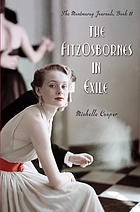
I have unbridled love for this second book of the Montmaray Journals. The enormous love I thought I felt for A Brief History of Montmaray pales in comparison for this longer, quieter, less axe-laden sequel. Our fictional royalty has moved off their island nation because of Nazi bombing, and now find themselves in London in the late 1930's as WWII is reving, fascism is creating divisions among and within the classes, and the city has no real understanding of what is in store for them just over the horizon.
Sophie, whose journal we're reading, Veronica, and the rest of the Montmaray Royalty... wait. Let me explain this first. That sounds all posh. It's not...
So, the first book, A Brief History of Montmaray, finds Sophie, her younger sister Henry and her cousin Veronica holding up the crumbling remains of their castle as her uncle the King gets progressively more insane, and her brother comes home more infrequently. They get by on selling the treasures of their formerly wealthy kingdom. They don't have much left and are the very picture of impoverished royalty. Then the Nazi's arrive. The Nazi's have their eye on their small but strategically located island nation for a couple of reasons. The impact of this results in lots of drama, some lethal axe-wielding, and some things that aren't going to be shared with the high society the group finds themselves plunged into at the start of FitzOsbornes in Exile. They've lost control of their beloved and historic nation, and they want it back. Now in the titular exile, and having fled to London and the estate of their long-expat, and very wealthy, Aunt Charlotte, the girls find themselves torn between Charlotte's expectations (they must be presented to society as proper royals of the highest order, and find very wealthy husbands) and their own concern for Montmaray. The girls, however, are far past the pretentious and uselessness of one ball after another (even if Sophie sometimes doesn't hate it), and their goal is to speak to the League of Nations and secure support for them to reclaim their island. But, royal or not, they're just a bunch of teenagers from a country no one remembers existing.
It is beautifully written and character-driven, full of fascinating historical and political details that are so perfectly woven into the plot that there is nary a single example of those pesky info-dumps so frequent in epic historical novels like this. You will learn a ton about the era without even realizing it - and it's definitely not at all the point. It perfectly captures the atmosphere of the location and time. None of it could have happened anywhere else. What you have is a quintet of characters desperately trying to grow up while being respectful to their heritage in a most tumultuous time. Oh, and due to the youngest of the clan, it's also often quite hilarious. It's not easy to prep a tomboy used to having reign of an entire island to become a debutante someday. Luckily (?) for Henry, we know that by the time she comes of age, there won't be so many balls.
The balance of fantastic, fully-developed, and lovable (no mere likable here!) characters set in a fascinating fully-realized setting, with a plot that is seemingly insurmountable for anyone, except maybe the particular talent combination of these characters, makes this a book that will always have a place in my heart alongside my rabid love for Ellen Emerson White's President's Daughter series, and Megan Whalen Turner's Attolia series. Cheesy or not, there you have it. Total fawning love.
Oh, and FitzOsbornes at War will be out on October 9, 2012. I can't tell you how happy it makes me to know that I get another one. Sadly, it looks like that's the final one, making this a trilogy, when I was hoping for a series taking us at least to 1945. Something epic like that.
Comparisons to I Capture the Castle are of course obvious, but even the most rapid fan of Dodie Smith's classic will not be disappointed with this trilogy.
As for the cover: Kelly pointed out some crazy about it some time ago, but regardless of phantom smoke (which until she said something, I'd just assumed it was light from a window I couldn't see), I think that it perfectly captures the tone of the book. Sophie right there in the thick of things, but still outside, looking in, and observing with an eye more aware than even she realizes.
Now, those other books I was planning to tell you about:
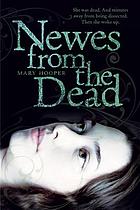
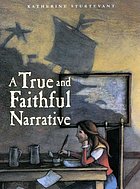
Once upon a time I interviewed the author, and reviewed this one. It's based on a true account of a girl who failed to die when hanged, and was paralyzed, but fully aware, as the medical community of 1650 prepared to preform an autopsy. If you poke around enough, I bet you can find a digital version of the pamphlet this story was based on.
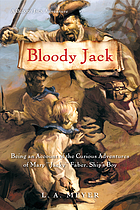
Ok, I'll be honest here. I stopped reading this series. No, not like that. I switched to consuming these on audio. Katheryn Kellgren is THAT GOOD. She is, in my opinion, the absolute best audio narrator out there today. She rivals Jim Dale in talent. I'm not kidding. The ninth (!!) book in the series was just released in October, and while this series has covered almost every ocean and continent on earth, Bloody Jacky Faber often returns to good olde London (and Boston!). When she's not fighting pirates or the British government itself. The first book is most effective in its depiction of life a street urchin in the 1790s, and how desperate that life was.
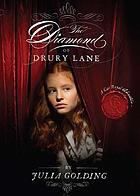
Very much a Jacky Faber with a bit less sparkle, this still raucous adventure series starts with Cat being abandoned in a theater in London around 1790. There's more focus on mystery than with Jacky, at least in the first novel, and much more focus on slavery for the whole series (I've liked what I've read, but I haven't read them all).
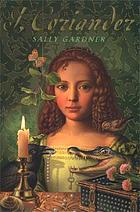
An older title with tinges of fantasy, this is set in Cromwell's England. As with any situation of tyranny, it's a frightening and precarious time where any misstep can end with deadly result. I posted about this one way back in 2006 (!). Notable mostly for the setting during the English Reformation and the fascinating (and/or horrifying) political situation, as well as the unusual combination of fantasy. I still think there should be more books set during this time period. Gardner has since come out with The Red Necklace and The Silver Blade about the French Revolution, which has been recommended with the highest enthusiasm, but I've yet to get to it. But I will.
Reviewed back in 2007 (I'm really mining the archives here, aren't I?) this is set just a bit after I, Coriander, during the Restoration. Meg desperately wants to be a writer, but in the 1680's the "gentler sex" were not respectable writers. This remains a favorite four years later.
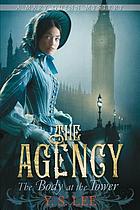
I haven't yet read the second in this series, The Body at the Tower, but the interwebs reveal that the third book, The Traitor and the Tunnel was released in the UK in August. I'm hoping to see this hop the pond, because I was pleasantly surprised with the nuance of the first title, A Spy in the House. It was just a Victorian mystery, it explored every aspect of class of the time, from the upper, to the poor, to, most interestingly, the hidden Asian population of London.
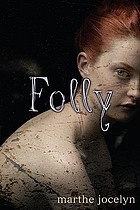
Speaking of Victorian... This was a tough read. One thing you have to know is that there was no tolerance of unwed pregnant servants during this era (and several after). A maid would find herself ruined if she were to be discovered to be pregnant. She would get dismissed without reference, reputation ruined. Many of that era then found themselves in squalor, and often turning to prostitution to survive. Mary Finn is lucky, comparatively, but she's still got a hard road in front of her. Side note: Holy new cover! I hadn't seen this, and I think it'll reach more readers than the original.
*and read Colleen's book The Map of My Dead Pilots!
Friday, November 04, 2011
All the Earth, Thrown to the Sky or Pretty, Pretty Titles sometime aren't
"The wind could blow down a full-grown man, but it was the dust that was the worst. If the dust was red, I could figure it was out of Oklahoma, where we were. But if it was white, it was part of Texas come to fall on us, and if it was darker, it was probably peppering down from Kansas or Nebraska.
Mama always claimed you could see the face of the devil in them sandstorms, you looked hard enough. I don't know about that, it being the devil and all, but I can tell you for sure there were times when the sand seemed to have shape, and I thought maybe I could see a face in it, and it was a mean face, and it was a face that had come to puff up and blow us away" p 1.
Found here.
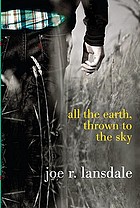
There's nothing left in Oklahoma for Jack Catcher. His parents are dead; his mom from the dirty pneumonia of the dust storms, his dad, suicide. There's nothing left for Jane and Tony Lewis either. Their dad got run over by his tractor as he fruitlessly tried to plant in dead ground, and their mom disappeared as easily as the good farming soil that used to provide a living for both families. It's the Great Depression, and there's nothing left for anyone, so the three of them might as well set out and just hope for something better than the nothing they've got. There's nothing to lose but their sorry lives - which might be exactly what the wind takes next as they spin from one adventure to the next, stealing cars, hopping trains, running into murderous bank robbers and criminal farmers and traveling circuses.
To my disappointment, while the writing is always beautiful, as the madcap - well, madcap isn't quite the correct word as it implies a levity that the book lacks, but we'll go with it - as the madcap plot revs up it never quite matches the tone of the writing. Does the writing match the barren setting? Yes. The hopeless era? Definitely. What you essentially have in this novel is an old-fashioned adventure plot that has potential for serious consequences. But despite the horror of the first chapters, and even of the repeated danger of the subsequent events, there is a distancing that takes away the visceral impact the first chapter had, and therefore removes the feeling of true danger the events warrant. Now, of course, that's my interpretation, so perhaps others felt differently while reading. However, when you never really believe the worst will actually happen to the characters, dire situations become less threatening and that bleak, hopeless writing doesn't have anywhere to go.
This is what I believe the intent to be: I think Lansdale wanted the plot to mirror the uncontrollable dust storms with three kids swept up in adventure and danger as though they were the earth that had lost its ground. It is in part, successful. But not entirely. After those first few chapters I never felt invested in Jack Catcher again. He's overshadowed by Jane and her lying ways (despite the fact that we never really understand quite why she's so pathological in her falsehoods). The driving force is not so much the wind and it's random ways, as it is Jane. Now, does Jane personify the wind? Perhaps. Everyone and thing must fall in line with her whims, and she'll say anything to make it happen. Which is not bad, but if this is her story, and Jack is detritus that helps her on her way, her character isn't quite developed enough for the reader to become anything but irritated at how she gets in everyone's way by lying outrageously each time she opens her mouth.
It ceased to be the character driven novel one would expect from the opening chapters and the traditional "road trip" theme, and became merely a series of crazy events that were not only improbable in a setting that was all too real, but didn't possess gravitas in tune with that beautiful opening. You can't have a character be the driving force unless you want to have a character-driven plot, and you can't have a plot-driven plot diven book unless you want to invest in some sort of logic to the series of events. What happens in cases like these, when you don't pick a side (or fail to invest enough in either side), is that the whole thing flounders. And that's what happened here. It just got boring. Which, HELLO, there are murderous robbers, and kindly old ladies, and alligators, and carnies, and... and... WHY WAS THIS BORING?
"The humming blackness came doen from the sky and hit the willows down below, and in a moment the grasshoppers ate the green off of them, and the willows shook like they was in a high wind, but the only wind was the wind the grasshoppers made" p 76.
It may appeal to those who liked As Easy as Falling of the Face of the Earth by Lynne Rae Perkins. Or those who really dig the old-time romantic bank robbers and gangsters from that era like Bonnie and Clyde and Babyface Nelson, who were clearly inspiration to the plot. Although those looking for that subplot will probably be left wanting more than the book delivers on that subject. It was beautifully written on the technical and art side, but lacked both plot and character development.
Copy obtained through publisher, Delacorte Press. Started to read because I wanted to, finished because it is a Cybils 2011 YA Fiction nominated title.
Monday, October 10, 2011
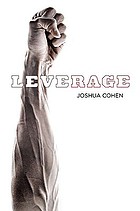
Leverage by Joshua Cohen, or There's No Way this Book Doesn't Feature Roid Rage
Which is totally true, by the way. Lots of steroids, and all the ways that drug can destroy things in high school.
The three football captains are the king of the school, and no one, no matter how talented in any other sport is excused from their bullying. Especially not the gymnastics team. Danny has a real chance at eventually qualifying for the Olympics in gymnastics and Kurt is a stuttering hulk who’s new to the school and the football team. Neither of them like the bullying, and they forge an unlikely friendship that is in jeopardy after they both witness a graphic attack that has tragic consequences. Leverage has some of the most awesome sports writing I’ve ever read, but this is also the most intense and possibly disturbing book I have ever read, so I recommend it to more mature readers.
Kurt is damaged going into the story. He's a foster kid, and in his last placement he experienced treatment that will scar him for his entire life. This is told in flashback in slow and desperate reveals, and the memories send him into a red rage. Danny and his teammates have been trying to hold their ground, retain their dignity, and fight the football team for access to the weight room, something they all know they need to be able to truly compete on the level they aspire to. But every which way they turn, they keep running into the immovable bulk of the impossibly large football team.
Characters are flawed, even broken. Some come into the tale that way, others will fall apart right before your eyes. You will hold your breath and read faster to get through the dark, drastic, brutal parts, most likely wiping tears of fury or sadness away as you turn the pages. They make huge mistakes out of fear and shame and pain. They suffer consequences that will haunt them.
I wish I could say that these kids experience abuse and bullying so brutal that it is unbelievable, but sadly, we all know that isn't true. And that's one reason I think that this book is important. Maybe it will help some kid out there find his voice and stop the cycle. Get help. It's a solidly upper high school read, unless you know, or have an inkling, that it's something an 8th or 9th grader may have had some experience with. Or the kid's just a fan of A Child Called It (I jest, don't give it to those 5/6th graders).
The horrible thing is that it is all so frighteningly believable. Until you get to the Hollywood ending, where you witness a shift from bleak to a resolution that doesn't match the tone of the rest of the book. Which, while satisfying, doesn't ring true, because despite the honesty in which the rest of the novel was handled, this was just a little too neat. A little too grand. A little too unrealistic. That's not how these stories ever end in real life. Fine, usually, for most novels. But not when nary a punch was withheld during the previous 270-ish pages.
I will admit that I booktalked this (along with around 30 other titles) this past June for 7-10 graders. I did so ONLY with a strong emphasis on the graphic nature of the story, and encouraged the teens to self-censor if they didn't think they were ready for it, but that I thought that it was an important story because this level of abuse and bullying does happen. I had warned the school librarians and teachers of the title before I talked it, and after hearing about it, I had specific requests from a few teachers to be sure to share it with some classes, which I found very interesting. Of the 875 holds I placed for students after my June visits, there were 25 for this title.
Recommend for older fans of:
Ellen Hopkins. Patricia McCormick. Compulsion by Ayarbe. Courtney Summers. Dirty Little Secrets by Omololu. Laurie Halse Anderson. Anything brutal.
Thursday, October 06, 2011
Between Shades of Gray (mini post)
Between Shades of Gray by Ruta Sepetys

wow.
"'Nothing could be worse than Stalin," said one of the men at the dining room table. 'He is the epitome of evil.'
'There is no better or worse,' said Papa, his voice low. I leaned farther around the corner to listen.
'But Hitler won't uproot us,' said the man....
'My point is that we're dealing with two devils who both want to rule hell'" p168.
wow.
Tuesday, October 04, 2011
Books I Want to Read
Here's a post of non-content for you. I want to read:
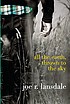
All the Earth, Thrown to the Sky by Joe R. Lansdale. Because that is a beautiful title, and the writing continued to be beautiful when I started. Unfortunately the Cybils nominations began, and I really can't read or finish anything that isn't on that list for the next three months. I read the first chapter aloud to my insanely critical husband, and even he was impressed.
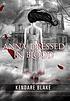
Anna Dressed in Blood by Kendare Blake. Because I haven't read a good ghost story since Beating Heart by AM Jenkins. Or Whitcomb's A Certain Slant of Light. Whichever came out later. I shouldn't be able to count good ghost stories published for teens on one hand.
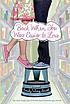
Back When You Were Easier to Love by Emily Wing Smith. Because I truly loved The Way He Lived, and I very much want to see more from her. It's been out since April, so the only excuse I have is that I've never once seen it on the shelves here at my library.
Between Shades of Gray by Ruta Sepetys. Because everyone seems to be falling over themselves for this, and because I've been waiting for my hold to come in FOREVER. Which is really unusual for a first-time novelist. Although, Amanda did say "It's no Book Thief." But, really, what is?
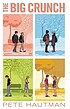
Big Crunch by Pete Hautman. Again, this one's been out for ages. I think for the first 6 months I wasn't able to even understand that this brightly colored cover actually had Pete Hautman's name on it.
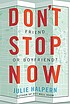
Don't Stop Now by Julie Halpern. Because I loved Into the Wild Nerd Yonder with unbridled passion. And the title reminds me of the Queen song.
Everybody Sees the Ants by AS King. Because I think AS King is one of the truly fresh voices of YA.
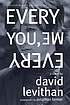
Every You, Every Me by David Levithan. Because it's David Levithan. Even though the cover model looks just not-Joseph Gordon-Levitt enough to weird me out.
A Plague Year by Edward Bloor. Because how many books for teens have you read about meth?
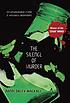
The Silence of Murder by Dandi Daley Mackall. Because I'm curious as to what happens when a someone who's written a metric ton of horse books for tweens writes a murder mystery for teens. I tend to forget that she also wrote Eva Underground (which I liked a lot), and a few other teen titles.
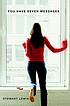
You Have Seven Messages by Stewart Lewis. Because there's a certain 13 Reasons Why angle there, but I'm hoping for a little bit more depth.
I don't think I meant for this list to get so long... lala, back to Cybils madness. Have you submitted your nominations yet?
Sunday, September 25, 2011
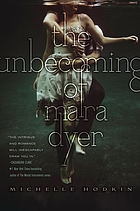
The Unbecoming of Mara Dyer, or Psychological is better than Paranormal
Mara was in a coma for three days. Upon awakening, she is told that her life-long best friend, her boyfriend, and another girl, died in the accident that plunged Mara into unconsciousness. Understandably haunted by the events, the loss of her memories surrounding the accident, and the loss of her friends, Mara is diagnosed with post-traumatic stress disorder. Her entire world is a reminder of what she's lost, and she manages to convince her family to move away and start new lives in Florida, where she continues to struggle with reality, but with the eventual addition of a couple new confidants.
Mara's family is awesome. The characters are excellent. Their interactions are immensely believable. You love the family and the love interest even as they walk up and smile at that line that would make them a little too perfect. Even the villains are enjoyable, albeit less dimensional. Sadly, the character of Jamie, who plays the role of first new friend, and openly refers to himself as the token black Jewish bi-sexual, entirely disappears two thirds of the way in. There's an explanation for it, but it's weak.
For 300 pages, this was a compelling psychological exploration of a fragile, damaged, teen mind coping with tragedy and change. And then, suddenly, all of that subtlety was thrown out on page 309. Look. It's a heck of a lot harder to get a reader to buy into an unreliable narrator working with a sliding scale of reality than it is to simply throw in super powers - it's a heck of a bigger feat as a writer, too. Hodkin did it. I was totally on board with this damaged girl. It was brilliant. And then it all gets cheapened with paranormal solutions. I don't believe that the story needed paranormal elements. I'm ranting about this, but I feel that it's almost like this beautiful, straight psychological novel got marred by a sudden infusion of deus ex machina. There was a fantastic way out of the story without using the fantastical.
Now, don't let me confuse you, the ground work for the paranormal elements was set early on, they were definitely there, but those elements were far more compelling with a straight, non-paranormal, interpretation. "Is she nuts? Is she hallucinating? Is it the PTSD? A coping mechanism? A psychotic break? Is she a murderer?" Nah, she's just got super powers. It literally, up until page 309, could have gone either way, and in my inconsequential opinion, it went in the wrong direction chasing a fad that's already blotto.
I've clearly my knickers in a twist over this, and I do want to say that despite my plot issues, everything else stands up pretty well. It's quite well written and compelling. The dialog is lively with well-executed and clever banter. The romance has chemistry, even if it was a tad contrived (the hottest guy in school that every girl wants, with an English accent. But he's only got eyes for her, and that makes ALL the popular girls conveniently hate her.). Whatev. I can imagine a bond between them being shared through traumatic pasts (non-paranormal explanation) or through magic (paranormal explanation), which means it works.
It ends in a blatant cliffhanger.
Recommend as an interesting match to Liar by Larbalestier, Compulsion by Ayarbe, and The River by Mary Jane Beaufrand, as well as Choker by Woods. It also goes well with Lisa McMann's Wake Trilogy and Nova Ren Suma's Imaginary Girls; two others I think would have been stronger had they chosen to follow straighter genre lines.
300 pages. I still can't get over that.
Wednesday, August 24, 2011
Where Things Come Back, or let's hope the cover doesn't
Did you know that many of the youth awards accept field nominations? I've never nominated anything. Until now. I actually field nominated Where Things Come Back by John Corey Whaley for the Morris Award. It turns out that you don't find out what happens after you nominate something, but I'm happy just to force a committee to read something that I believe in.
Yes, I do enjoy being evil.
Before Gabrielle disappeared, Cullen Witter held onto the hope that he wouldn't end up trapped in tiny Lily, Arkansas. He bides his time by coming up with book titles and imagining the zombie apocalypse (especially zombies attacking people who annoy him). Without Gabrielle, Cullen does his best to maintain normal amid pain and absurdity when the town forgets one of their own has gone missing and instead becomes obsessed with the reappearance of a supposedly extinct woodpecker. But if a bird can reappear after 60 years of assumed extinction, surely a little brother can come back, too. This is a coming of age tale of hope, redemption, grief, and wonder.
I stumbled upon this book by sheer luck. I peruse all new teen titles that come into the library, and often set several aside to share with my teen advisory board, or book group. This was one of the random newbies that came in several months ago, and I was so captivated by the quirky jacket flap that I had to read it. But let's face it, it was probably the promise of zombies. You know me.
I'm not going to pretend that this is anything other than an odd book. It's weird. There's a B plot going on there that seems rather inconsequential for a long time. It isn't, of course. Adding to the quirk factor is the fact that Cullen occassionally slips from first person into third as he distances himself from pain, embarrassment, or boredom, and starts narrating his life as though it were just a chapter in a book that he could close when things get to be too much. Cullen wants to be a writer, and maintains a growing list of book titles inspired by the happenings around him.
What Whaley has created is an unusual story that never fails to captivate despite its oddities. It's also wryly humorous (the book titles), and so well-structured that it calls for an immediate re-read. It feels fresh even while covering the well-trod small-town and missing child plots, and reminds me of The Perks of Being a Wallflower, or John Green before he got tediously repetitive. For newer titles, Where She Went by Gayle Forman, The Lucky Kind by Alyssa B. Sheinmel, and Okay For Now by would probably be good matches. I will definitely be watching to see what's next for this first-time novelist. Regardless of whether the Morris committee agrees with me.
If you are a NPR nerd like me, you might have heard the NPR feature about the real return of the Ivory Billed Woodpecker. The story was framed by a Sufjan Stevens song The Lord God Bird. I believe (but don't quote me) that this story, which stuck with me for so many years, was what inspired John Corey Whaley. So, that Lazarus burger and haircut in the book? Yeah, that really happened. In Brinkley, Arkansas.
The potshot about the cover is perhaps unfair since it is appropriate for the story, however, I can't deny its questionable appeal to the intended audience. But perhaps the kid who would pick this one up because or in spite of the cover would be the exactly right audience for it.
Subscribe to:
Posts (Atom)